2026 LCAQD Synod Sunday Sermon
SYNOD SUNDAY SERMON 7 JUNE 2026 PENTECOST 2
Text: Titus 3:4-7: When the kindness and love of God our Saviour appeared, he saved us, not because of righteous things we had done, but because of his mercy. He saved us through the washing of rebirth and renewal by the Holy Spirit, whom he poured out on us generously through Jesus Christ our Saviour, so that, having been justified by his grace, we might become heirs having the hope of eternal life.
I think it’s fairly accurate to say that as Christians, we’re living in a time filled with uncertainty, instead of confidence. Many things we used to assume about the Church’s future, don’t feel certain anymore. The Church’s role in the West is changing fast, and many communities feel fragile. Yet, there are surprising signs of life. People are spiritually hungry, searching for God, showing that the risen Christ may not be finished with his Church yet. Which he of course isn’t. But sometimes we forget that. Or we struggle to believe it.
At Synod this year, we come together to listen, not just to each other, or to reports and debates, but to hear what the Holy Spirit is saying to the Church. Over the last years, you may have heard me say that synod isn’t just about reports and proposals and decision. At its heart, and most importantly, it’s God’s people gathering to listen to what the Holy Spirit is saying to the Church. At Synod this year, we are reminded that one of the clearest examples of this in Scripture, is the Council of Jerusalem in Acts 15. The early Church gathered during a time of uncertainty and tension. They listened, prayed, and discerned together. In the end, they could say, ‘It seemed good to the Holy Spirit and to us’ (v.28). Not ‘It seemed good to us,’ but ‘It seemed good to the Holy Spirit and to us.’
This is how the Church approaches things. We don’t just make decisions, we discern, we listen, and we try to hear what the Holy Spirit is saying. We may come to Synod with one opinion, but we are called to listen to the Holy Spirit. And that may mean that we leave with another opinion. This also happens in the daily lives of our congregations.
Waiting and listening can be hard. When we feel uncertain, we naturally want control, solutions, plans, and certainty. Churches are no exception. But our passage from Titus, gives us a very different starting point. It’s not about what we do, but about what God has done for us. The focus is on God’s initiative, not ours. Paul writes, ‘When the kindness and love of God our Saviour appeared, he saved us.’ The word ‘appeared’ is important. God’s mercy enters the world, and God takes action. Notice what Paul doesn’t say. He doesn’t say, ‘When the Church became strong enough,’ or, ‘When we found the right strategy.’ He simply says, ‘He saved us.’
Not, ‘We saved ourselves,’ or, ‘We renewed ourselves,’ but, ‘He saved us.’ The Church doesn’t create its own life; it receives it. This is a key truth we need to remember today. When churches get anxious, we often think renewal depends on us. If only we had the right structures, leaders, or plans, then renewal would happen. But Paul says: ‘He saved us, not because of righteous things we had done, but because of his mercy.’ The Church lives by mercy. Not by achievement. Not by success. Not by institutional strength. Mercy.
Paul then gives us a powerful image: ‘He saved us through the washing of rebirth and renewal by the Holy Spirit.’ The early Church, Luther, and we today, all hear Baptism in these words. God washes, renews, gives new life, and pours out the Holy Spirit.
So renewal isn’t about chasing something new. It’s about returning; not to a made-up golden age, not to constant re-invention, and not to anxious activity. It’s about coming back to the font, to Baptism, to mercy, and to Jesus Christ. The Church doesn’t reinvent herself; she returns to what God has already made her to be. Renewal means remembering, repenting, and being reborn each day.
Luther explains this well in the Small Catechism. What does Baptism mean? ‘That the old creature in us, with all sins and evil desires is to be drowned and die, through daily contrition and repentance, and on the other hand that daily a new person is to come forth and rise up.’ The key word is ‘daily.’ Renewal isn’t a one-time spiritual event. It’s about dying and rising each day, returning to grace, daily. Hence, spiritual renewal isn’t about institutions. It’s about Baptism and the Holy Spirit drawing us back to Jesus Christ, again and again.
This is especially important for the Church today. In many ways, we are learning again what it means to be in exile. The prophet Ezekiel, in the Synod Old Testament reading, knew exile. Jerusalem had fallen, the temple was in ruins, and God’s people were taken to Babylon. In exile, people wondered: Has God abandoned us? Can renewal still happen here?
You may remember the words from Psalm 137 verse four: ‘How can we sing the Lord’s song in a strange land?’ That’s the background of today’s Old Testament reading. And God answers the questions of his people: ‘I will sprinkle clean water upon you.’ ‘A new heart I will give you.’ ‘I will put my Spirit within you.’ Again, notice who is acting. It’s not God’s people, but God.
The people in exile cannot rescue themselves. They cannot engineer their own renewal. Renewal comes from God’s initiative, mercy, and action. Maybe this is exactly what the Western Church needs to hear. We often react to uncertainty with anxiety and frantic efforts to fix things. But Ezekiel reminds us: God brings new life to what seems dead, gives new hearts, and pours out his Spirit on tired people, in exile.
And perhaps this is where our image of the Five Doors becomes so important in our district’s new Strategic Charter, which is being launched at this year’s Synod. This Synod we reflect on those Five Open Doors within the Strategic Charter: The Open Door to Spiritual Renewal, the Open Door to the World, the Open Door to the Church, the Open Door to Collaboration, and the Open Door to the Future. But we must remember something essential. These are not ultimately our doors. Jesus says: ‘I am the door.’
Hence, the Church’s future doesn’t depend on us creating, or forcing, doors open. God is already at work. We don’t bring Christ into a world where he’s absent; we step into a world where God is already present and active. This means our mission shouldn’t be driven by anxiety, because it’s not our mission, it’s God’s mission, the missio Dei. God is already acting, calling, stirring hearts, and opening doors. The Church is invited to notice where the Spirit is moving and join in.
This is a common pattern in the Bible. God’s renewal rarely shows up where we expect it. Sarah laughs, dry bones come to life, exiles return home, and a crucified Messiah rises from the dead. Renewal comes as a gift, as grace, and as a surprise. And perhaps this is one of the great biblical patterns, when the Holy Spirit moves, things can change remarkably quickly.
What seemed flat and lifeless, suddenly feels full of possibility again. And perhaps we are beginning to see something like that, in parts of the Church today. In many places across Australia, and indeed globally, there are signs of renewed spiritual hunger. People searching again for meaning, prayer, sacramental life, forgiveness and hope. Churches that expected only decline, are suddenly finding new life, emerging in unexpected ways.
Not everywhere. Not all at once. But there are signs that the Holy Spirit is still at work, among God’s people. And perhaps that is important for us to hear. Because renewal is not something we manufacture. We cannot engineer it into existence through enough effort, or anxious activity, or planning. If God is not in it, no number of Strategic Charters will get it done.
The Spirit blows where he wills. And when he does, things begin to change. Hearts are opened. Faith is renewed. Hope returns. People begin once more to imagine that God may yet have a future for his Church. To prepare not only for survival, but also for revival. And surely that must also become our prayer.
That the Holy Spirit may renew us. Renew our congregations. Renew our life together. Renew our witness to Christ. Not for our sake alone, but for the sake of the Gospel and for the life of the world. And so we desire renewal. We pray for renewal. We hope for renewal. That’s a very Lutheran thing to do. Because we are reborn in water. Renewed by the Spirit. Sent in Christ’s name.
Bishop Mark Vainikka, LCAQD
Synod Sunday 7 June 2026
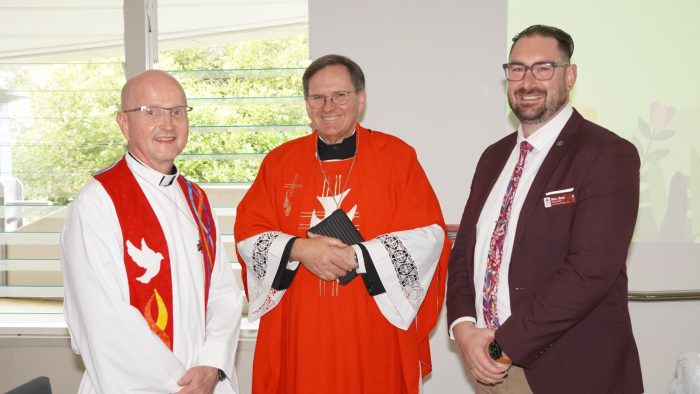
Image: LCAQD Bishop Dr Mark Vainikka, LCANZ Bishop Paul Smith and LCAQD First Assistant Bishop Ben Hentschke at St Andrews Lutheran Church Tallebudgera on Synod Sunday.


READ MORE STORIES ABOUT LCAQD Synod 2026, Synod, Synod Sunday Sermon