A story of renewal
A story of renewal – St Luke’s Woodridge and the Good Shepherd Chapel at Trinder Park
The Church is not defined by its buildings, but one constant is the gathering of God’s people around Word and Sacrament. Yet the spaces in which we gather are not neutral. They give visible expression to what we believe, and they quietly teach us what to expect when we come together for worship, and witness to our priorities, our practices, our faith.
The connection between St Luke’s, Woodridge and Trinder Park reflects a pattern well known in the Lutheran community in Queensland: to be present where people are, particularly in times of vulnerability, and to continue the ministry of Word and Sacrament in those places.
A time for uplift and renewal
In the past few years changing demographics in the aged care space reshaped patterns of worship at Trinder Park. While chaplains provide three services each week across the campus, the dedicated chapel has been used less frequently, primarily for funerals and other occasional services.
So in Advent 2025, St Luke’s congregation moved to the Good Shepherd Chapel at Trinder Park. This move gave us an opportunity to reflect more carefully on what a worship space communicates and how it serves the life of the Church.
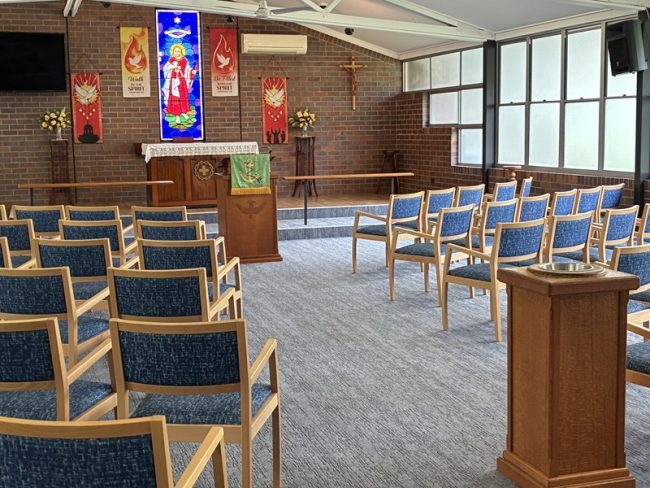
A modest refurbishment of the chapel before its new tenants moved in took seriously the fact that the way a worship space is arranged does more than organise furniture—it reflects what a community values. As such, the layout seeks to intentionally express and promote a Lutheran understanding of Word and Sacrament while also encouraging participation, connection, and welcome.
Near the entrance to the main worship space stands the Baptismal Font, signifying that Holy Baptism is the sacrament by which we are incorporated into Christ and his Church. Its position at the threshold is not accidental: it marks the beginning of the Christian life and reminds us that entry into the Church is always by God’s grace.
The Paschal Candle, placed nearby, connects baptism with Christ’s death and resurrection, grounding the life of the Church in that central reality.
At the centre of the space stands the lectern, from which the Scriptures are read and proclaimed. This reflects the conviction that the Church is gathered and sustained by the Word, through which God continues to speak and act.
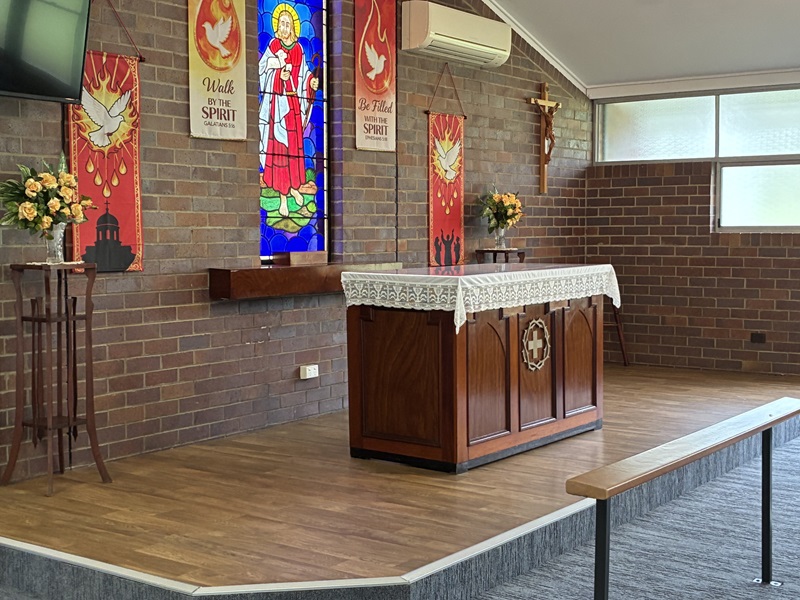
The altar is positioned a couple of small steps higher than the main worship space, centrally on a wooden floor, giving it subtle prominence. It also gives the pastor space to preside at communion from behind the altar – facing the congregation – suggesting communion is something around which the people gather.
Hence the three central prominent furnishings of font, lecturn and altar are placed on a central axis, to suggest their complementarity.
Less noticeable changes were the reduction of the altar rails, as a way of reducing any sense of division while retaining support for all to come forward to receive the gifts given there.
The reredos behind the altar, a shelf which in more traditional churches is notionally attached to the altar, provides a place for flowers and other things which also keep the altar clear for the sacramental vessels.
Seating is arranged on an angle. By allowing the congregation to see one another is to encourage a sense of community rather than observation. This helps shift the experience from watching a service to participating in a shared act of worship.
The chapel nave
A gentle challenge
It is easy to think of church buildings in purely practical terms: what fits, what works, what is familiar. Yet every decision about space also communicates something—about what we believe matters, about where attention is directed, and about how people are invited to participate.
If the font is hidden, baptism may seem secondary. Distinct spaces within the one building and barriers between them discourage the oneness of the people of God. None of this is usually intentional. But it does suggest that we can often do better—not by making spaces more elaborate, but by making them more truthful.
How much did it cost? Less than $5000.
A well-ordered space does not draw attention to itself. The space itself becomes part of the Church’s message and witness.
A happy postscript to this story is that over the first six months in their new home, 15-20% more people have found in St Luke’s a spiritual home.
Russell Briese
Annunciation of our Lord, 2026
As we reflect on the renewed chapel space at Trinder Park, Lutheran Services is also exploring the Origin Stories of Woodridge – capturing the memories and experiences that have shaped this community over time. If you have a connection to Trinder Park or the Woodridge services, we warmly invite you to be part of this by sharing your story. Please email contact@lutheranservices.org.au if you have a story to share.


READ MORE STORIES ABOUT Chaplaincy, Good Shepherd Trinder Park, Lutheran Services, St Luke's Woodridge